Invoice vs Receipt vs Quotation: What’s the Difference?
Having a business invoice presents your business as a professional because a business invoice and receipt help people see your business as professional business and not just anyhow business.
Invoice vs receipt vs quotation can be confusing when you are just starting a business, freelancing, selling products online, or providing services to clients.
All three documents can contain your business name, customer information, descriptions, prices and totals. They can even look almost identical when placed next to each other but they do completely different jobs.
A quotation tells a customer what you propose to charge, an invoice tells the customer what they need to pay, and a receipt confirms that the payment has been received.
A simple way to remember the difference is:
Quotation → Invoice → Payment → Receipt
Not every transaction will use all four stages, and some businesses may have different billing arrangements. However, understanding where each document belongs can prevent awkward conversations with customers, payment delays and messy business records.
In this guide, we will explain the difference between an invoice, receipt and quotation, show when to use each one, look at real business examples, explain common mistakes, and show how you can create a professional invoice online for free using the CodeAndCapital Invoice Generator.
Invoice vs Receipt vs Quotation: The Quick Difference
Before going into detail, here is the simplest comparison.
| Document | When is it normally used? | Main purpose | Does it request payment? |
|---|---|---|---|
| Quotation | Before the customer commits to the work or purchase | Proposes price, scope and terms | No |
| Invoice | When payment is due, according to the agreed arrangement | Requests payment and records what is being billed | Yes |
| Receipt | After payment has been received | Confirms that payment was made | No |
There is an important detail here.
An invoice is not necessarily sent only after a project has been completed. A business may invoice for a deposit, a milestone, a subscription period, goods supplied, or another agreed payment stage.
Likewise, a quotation is not simply a fancy price list. A good quotation can define what is included, what it will cost, how long the offer remains valid, and what conditions apply.
The documents therefore belong to different stages of the customer relationship.
What Is a Quotation?
A quotation, often shortened to quote, is a document that tells a potential customer what you are proposing to provide and how much it will cost.
It normally comes before the sale or before the work begins.
Imagine that someone contacts a web designer and says:
“How much will you charge to build a five-page business website?”
The designer may prepare a quotation containing:
- Website design and development
- Number of pages
- Contact details
- Mobile responsiveness
- Basic SEO setup
- Delivery timeline
- Total price
- Payment terms
- Quotation validity period
The customer can then review the proposal and decide whether to proceed.
What a quotation does
A quotation helps both sides establish expectations before money changes hands.
It can answer questions such as:
- What am I buying?
- How much will it cost?
- What exactly is included?
- How long is the offer valid?
- What does the customer need to provide?
- When is payment expected?
- Are there additional charges for work outside the stated scope?
This is particularly important for service businesses.
A graphic designer, photographer, software developer, printer, consultant, plumber, event decorator or construction company can all benefit from using quotations.
Is a quotation legally binding?
Do not assume that every quotation is automatically a contract or that every quotation is automatically non-binding.
Whether a quotation becomes legally binding can depend on its wording, acceptance, the surrounding agreement, applicable law and the circumstances of the transaction.
For that reason, businesses should be clear about terms such as:
- quotation validity
- acceptance
- scope of work
- payment terms
- cancellation
- changes to scope
- delivery conditions
A quotation should make the proposed transaction clearer, not create more uncertainty.
What Is an Invoice?
An invoice is a business document used to request payment for goods or services, according to the agreed terms.
In simple terms:
A quotation says, “This is what we propose to provide and what it will cost.”
An invoice says, “This is what you are required to pay.”
An invoice may be issued after delivery, at the beginning of a project for an agreed deposit, at a milestone, or periodically for recurring services.
For example, a freelance developer may agree to build a website for ₦500,000.
The quotation might state:
Website development: ₦500,000
50% deposit before development
50% upon completion
The developer may then issue an invoice for the ₦250,000 deposit.
The invoice is therefore not necessarily a completely new transaction. It can be the payment document that follows the terms already agreed in the quotation or contract.
What Should an Invoice Contain?
A professional invoice should make it easy for the customer to understand three things:
- Who is charging me?
- What am I being charged for?
- How much do I need to pay?
Depending on the type of business and applicable requirements, an invoice commonly contains:
1. Business details
Your business name and relevant contact information.
2. Customer details
The customer’s name or business name and relevant contact information.
3. Invoice number
A unique reference that helps you and your customer identify the invoice.
For example: INV-2026-001
4. Invoice date
The date the invoice was issued.
5. Due date or payment terms
When payment is expected, where a due date applies.
Examples:
Due on receipt
Due within 7 days
Due within 30 days
6. Description of goods or services
Do not simply write:
“Service”
when you can be more specific.
Instead:
Website design and development
or:
100 branded product flyers, A5, full colour
Clear descriptions reduce misunderstandings.
7. Quantity, rate and line totals
For multiple products or services, list each item separately.
For example:
| Item | Quantity | Rate | Amount |
|---|---|---|---|
| Logo design | 1 | ₦80,000 | ₦80,000 |
| Brand guideline | 1 | ₦120,000 | ₦120,000 |
| Business card design | 2 | ₦25,000 | ₦50,000 |
8. Subtotal and applicable charges
Where relevant, the invoice may show tax, discounts, additional charges and the final amount payable.
9. Payment information
Tell the customer how payment should be made.
For example:
Bank transfer
Payment link
Other agreed payment method
The exact information you should include depends on your business, location and applicable tax or invoicing requirements.
What Is a Receipt?
A receipt confirms that money has already been received.
This is the key difference between an invoice and a receipt.
An invoice generally says:
You need to pay this amount.
A receipt says:
We received this payment.
For example, a customer receives an invoice for ₦150,000.
They make the payment.
The business can then issue a receipt confirming the payment.
A receipt can include:
- Receipt number
- Date of payment
- Customer name
- Amount received
- Payment method
- Description of what was paid for
- Related invoice number
- Remaining balance, where applicable
A receipt is therefore useful for the seller’s records and the customer’s records.
Invoice vs Receipt: The Difference
This is probably the most common confusion.
Suppose you design a logo for a client for ₦80,000.
Before payment:
Invoice: ₦80,000 due
After the client pays:
Receipt: ₦80,000 received
The same transaction can therefore have both an invoice and a receipt.
They are not interchangeable.
A simple test
Ask:
Has the customer paid?
If the answer is no, you may need an invoice, depending on the agreed billing arrangement.
If the answer is yes, a receipt may be used to acknowledge the payment.
A receipt should not normally be used as a substitute for an unpaid invoice simply because the customer wants a document that looks official.
Quotation vs Invoice: What’s the Difference?
The difference is mainly about timing and purpose.
A quotation comes before the customer commits to the proposed purchase or service.
An invoice is used when payment is due.
Consider a freelance graphic designer.
A customer says:
“I need a logo, brand colours and a business card design. How much?”
The designer sends:
Quotation
Logo design: ₦100,000
Brand colours: ₦50,000
Business card design: ₦30,000
Total proposed price: ₦180,000
The customer approves.
The designer then requests the agreed deposit.
That payment request can be issued as an:
Invoice
The invoice may reference the quotation:
Quotation No: QT-2026-004
This creates a useful paper trail.
Quotation vs Receipt: What’s the Difference?
These two documents belong at almost opposite ends of the transaction.
- A quotation is about a proposed transaction.
- A receipt is about a completed payment event.
For example:
A photographer quotes:
Wedding photography package: ₦350,000
The client accepts.
The photographer receives ₦175,000 as a deposit.
Later, the client pays the remaining ₦175,000.
- A quotation could document the original proposal.
- Invoices could document amounts that became due.
- Receipts could confirm the payments actually received.
This separation makes the business record easier to understand later.
READ ALSO: HOW TO CREATE A BUSINESS EMAIL ADDRESS
Invoice vs Receipt vs Quotation: A Real-Life Example
Let’s use a small Nigerian business as an example.
Imagine a freelance website developer named Daniel and a small restaurant asks Daniel to build a website. The agreed project price is ₦300,000
Daniel proposes:
- Five-page website
- Mobile responsive design
- Contact form
- Google Maps integration
- Basic SEO
- Delivery within three weeks
Step 1: Quotation
Daniel sends:
Quotation QT-001
Website Design and Development
Total: ₦300,000
Valid for: 14 days
Payment terms: 50% deposit, 50% on completion
The client accepts.
Step 2: Invoice
Daniel now needs the first 50%.
He issues:
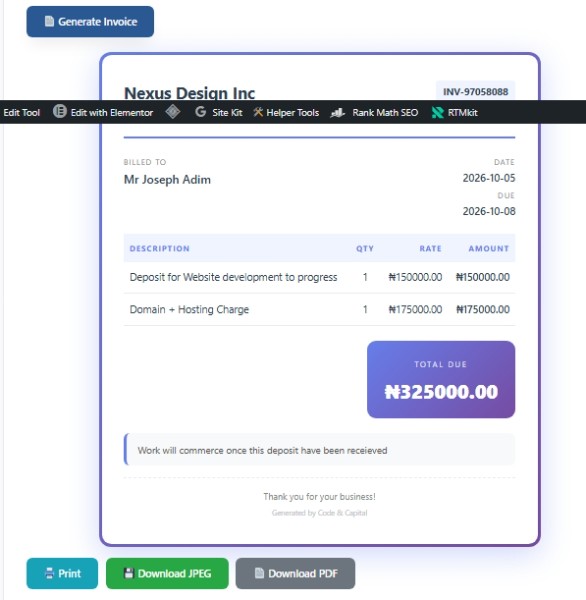
Invoice INV-001
Deposit for website development
Amount due: ₦150,000
The invoice is a request for payment.
Step 3: Payment
The client transfers ₦150,000.
Step 4: Receipt
Daniel issues:
Receipt REC-001
Payment received: ₦150,000
Reference: INV-001
Later, when the website is completed, Daniel issues the final invoice for the remaining ₦150,000.
This sequence is simple, but it creates a much cleaner record than sending random documents whenever someone asks for “a bill.”
What About an Estimate?
There is another document worth understanding: the estimate.
An estimate is generally a prediction of what something is likely to cost.
A quotation is usually more deliberate about the proposed price and scope.
For example:
Estimate
Website project: approximately ₦250,000 to ₦350,000 depending on the number of pages and features.
Quotation
Website development: ₦300,000
Five pages
Contact form
Mobile optimisation
Valid for 14 days
The distinction isn’t universal in every industry or jurisdiction, and some businesses use “estimate” and “quotation” almost interchangeably.
What About a Pro Forma Invoice?
A pro forma invoice is another document that can cause confusion because it looks very similar to an ordinary invoice.
It is generally used before a final invoice is issued, often to communicate expected charges or support a transaction that has not yet reached the stage of the final invoice.
The important point is this:
A document being called an “invoice” does not automatically mean it has the same purpose or legal/tax treatment as every other invoice document.
If a transaction has specific tax, customs, import, procurement or regulatory implications, use the applicable rules rather than assuming a pro forma invoice is equivalent to a tax invoice.
Common Mistakes Businesses Make
The problem is usually not that business owners don’t know the words.
It is that the documents get mixed up in real-world situations.
Mistake 1: Sending a receipt before payment
A customer says:
“Please send me a receipt.”
But they have not paid yet.
A receipt is normally used to acknowledge money received.
If payment is still outstanding, an invoice may be the appropriate document.
Mistake 2: Sending a quotation as an invoice
A quotation can contain prices and totals, but that does not automatically make it a payment request.
If the customer has already agreed to proceed and payment is due, prepare the appropriate invoice.
Mistake 3: Using vague descriptions
An invoice that says:
“Work done: ₦250,000”
is less useful than one that clearly identifies what was supplied.
Clear descriptions help both sides understand what the payment relates to.
Mistake 4: Reusing invoice numbers
A business should have a consistent numbering system.
Instead of creating:
Invoice.pdfInvoice New.pdfInvoice Final.pdfInvoice Final 2.pdf
use references such as:
INV-001INV-002INV-003
A consistent numbering system makes record keeping easier.
Mistake 5: Changing the price after quotation without explanation
Suppose a customer accepts a quotation for ₦250,000 and later receives an invoice for ₦330,000.
That immediately creates a problem.
- If the scope changed, document the change.
- If additional work was requested, identify it.
Your quotation, agreement and invoice should tell a consistent story.
Mistake 6: Treating an invoice generator as an accounting system
An invoice generator can make document creation much easier.
It does not necessarily replace:
- accounting software
- bookkeeping
- tax records
- payment reconciliation
- customer management
- statutory filings
- professional tax advice
This distinction is particularly important for growing businesses.
What About Invoices in Nigeria?
For Nigerian businesses, there is another important distinction to understand.
Creating a professional-looking invoice is not automatically the same thing as creating an invoice that satisfies every applicable tax or e-invoicing requirement.
Nigeria’s current Revenue Service has an official e-invoicing system with structured invoice requirements, validation and an Invoice Reference Number process. The NRS documentation states that its electronic invoice is a structured digital format and distinguishes this from simply taking a paper invoice and converting it to a PDF or image.
Create a Professional Invoice Online for Free
Creating an invoice does not have to mean opening Microsoft Word, searching for a template, adjusting tables, calculating totals manually and repeatedly editing the same document.
CodeAndCapital provides a free Invoice Generator designed to make basic invoice creation quicker and easier.
The tool is available without a sign-up requirement, and the CodeAndCapital tools page describes it as a way to create professional invoices with line items and totals.
What can you use it for?
It can be useful for:
- Freelancers
- Small businesses
- Consultants
- Service providers
- Designers
- Developers
- Tutors
- Repair technicians
- Creators
- Entrepreneurs
Rather than starting with a blank document, you can work from an invoice structure designed around the information a customer needs to understand the charge.
Why use an invoice generator?
A good invoice should clearly communicate:
- Who supplied the service or product
- Who is being billed
- What was supplied
- How much each item costs
- What the total is
- What amount is expected to be paid
That is why an invoice generator can be useful even for a very small business.
Try the CodeAndCapital Invoice Generator
Create a Free Invoice with CodeAndCapital’s Invoice Generator →
Invoice, Receipt or Quotation: Which One Should You Use?
When you’re unsure, ask where the transaction currently stands.
The customer has not agreed to the job yet
Quotation
You are presenting the proposed work, price and terms.
The customer has agreed and payment is now due
Invoice
You are requesting payment according to the agreed arrangement.
The customer has already paid
Receipt
You are confirming that payment was received.
The simple workflow is:
Quotation → Agreement → Invoice → Payment → Receipt
But remember that real transactions can vary. A business may receive payment immediately without issuing a separate invoice first, issue invoices at milestones, or use contracts and other documents alongside these three.
The important thing is that each document accurately represents what happened.
Do You Need All Three Documents?
No.
- A simple retail purchase may not require a quotation.
- A customer may walk into a shop, buy an item and receive a receipt immediately.
- A freelancer may have a long-term contract that already defines the pricing, making a separate quotation unnecessary for every billing cycle.
- A business may issue an invoice and receive payment without issuing a separate receipt.
- The goal is not to produce paperwork for the sake of paperwork.
The goal is to maintain a clear record of:
- what was offered
- what was agreed
- what was billed
- what was paid
The larger the transaction or the more complicated the relationship, the more valuable that paper trail becomes.
Frequently Asked Questions
Is an invoice the same as a receipt?
No. An invoice is generally used to request payment or document an amount due. A receipt confirms that payment has been received.
Can an invoice be issued before the work is completed?
Yes. Invoices can be issued for deposits, milestones, recurring services and other agreed payment arrangements. The timing should match the terms of the transaction.
Can I use a quotation as an invoice?
You should not assume they are interchangeable.
A quotation proposes the price and scope. An invoice is normally the document used to request payment.
Do small businesses need invoices?
The answer depends on the nature of the business, transaction, customer and applicable legal or tax requirements. Even where a particular transaction does not legally require a formal invoice, maintaining clear transaction records can still be valuable.
Can I create an invoice without accounting software?
Yes! A simple invoice can be created using a document editor, spreadsheet, template or invoice generator. We have made one available for you. Try Now
Is a receipt proof of payment?
A receipt is generally used as evidence that payment was received. It should clearly identify the amount received and, where relevant, the transaction or invoice it relates to.
Is CodeAndCapital’s Invoice Generator free?
Yes. The CodeAndCapital tools page currently lists the Invoice Generator as free and says no sign-up is required. It describes the tool as allowing users to create professional invoices with line items and totals.
Final Takeaway
Invoice, receipt and quotation are not three names for the same document.
They represent different points in a business transaction:
- Quotation: What are you proposing to provide and at what price?
- Invoice: What amount is now due according to the agreed arrangement?
- Receipt: What payment have you received?
Once you understand that sequence, business paperwork becomes much easier to manage.
And when you need to create a professional invoice without starting from a blank document, you can use the free CodeAndCapital Invoice Generator to create an invoice with line items and totals without creating an account first.

One Comment